
Anyone who has fallen hard for someone new knows the feeling: suddenly you’re listening to a genre of music you’d never touched, forming opinions about topics you used to ignore, maybe even picking up your partner’s turns of phrase or some of their habits.
It can feel disorienting, like you’re losing yourself. But according to a well established framework in relationship psychology, something closer to the opposite is happening. You’re not shrinking. You’re actually expanding.
And there’s a beautiful distinction here: expansive love versus consuming love.
Consuming love can make you smaller: abandoning your interests, neglecting friendships, suppressing needs, changing yourself to maintain attachment.
Expansive love tends to do the opposite. You remain yourself, but the relationship gives you additional room to become. Ideally, it’s not “I became half of a whole.” It’s “I was already whole, and loving you introduced me to parts of myself I hadn’t met yet.”
The Basic Idea
Psychologists Arthur and Elaine Aron introduced the self-expansion model back in the 1980s, and it remains one of the more influential ways researchers think about romantic attachment.
The core claim is simple: people are motivated to grow, to increase their sense of capability, and to broaden their understanding of the world. Close relationships are one of the fastest and most efficient ways to do that, because a partner effectively hands you access to their perspectives, skills, social circles, and resources.
When you fall in love, you’re not just gaining a companion, you’re absorbing a whole additional set of tools for navigating life.
Two Things Happening at Once
The theory rests on two related mechanisms.
The first is a basic motivational drive: humans want to feel more capable and effective, and they’ll pursue experiences and relationships that help with that.
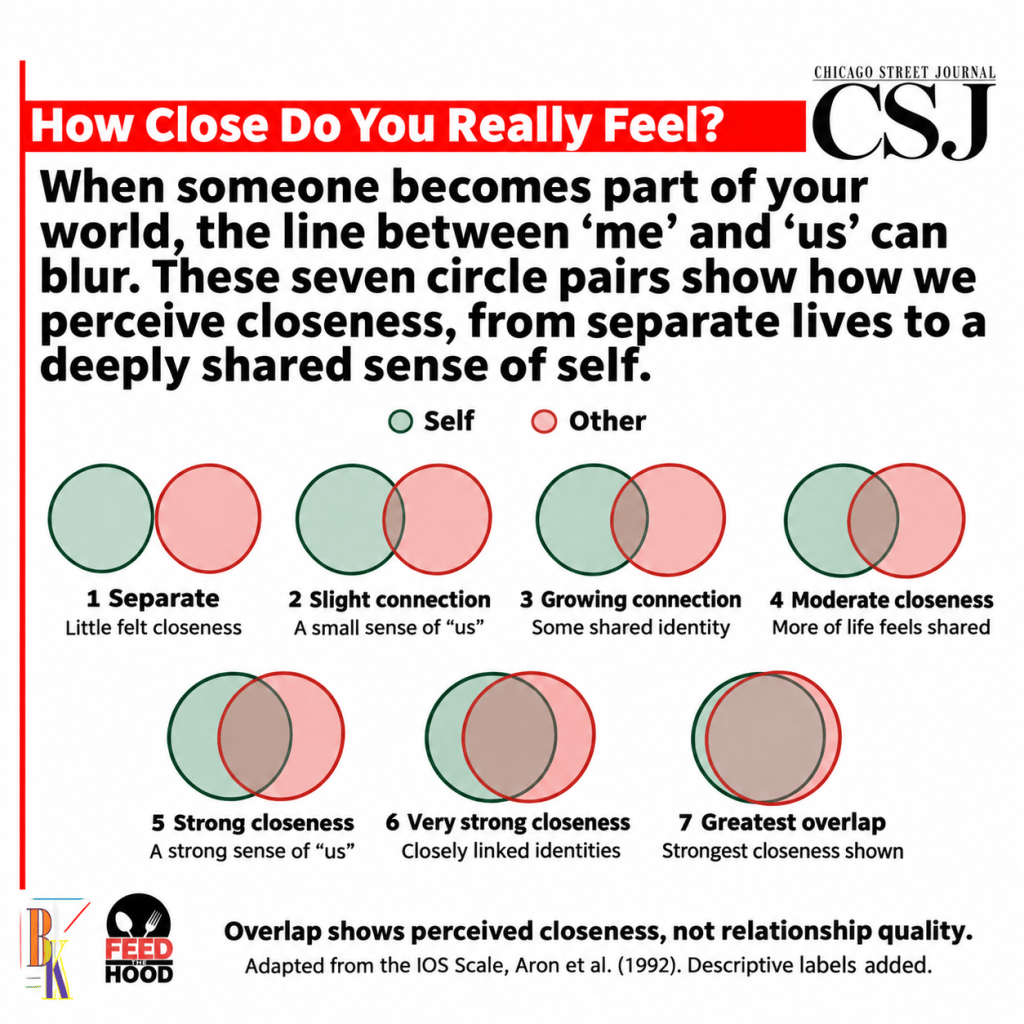
The second is what researchers call the inclusion of other in the self, essentially the psychological blurring that happens when a partner’s traits, opinions, and even memories start to feel like your own.
Aron’s lab demonstrated this in clever lab experiments showing that people process information about a romantic partner cognitively in much the same way they process information about themselves, as though the boundary between self and partner has genuinely softened.
The Tool Behind the Research
To actually measure this blurring, Aron developed a wonderfully simple diagram called the Inclusion of Other in the Self Scale.
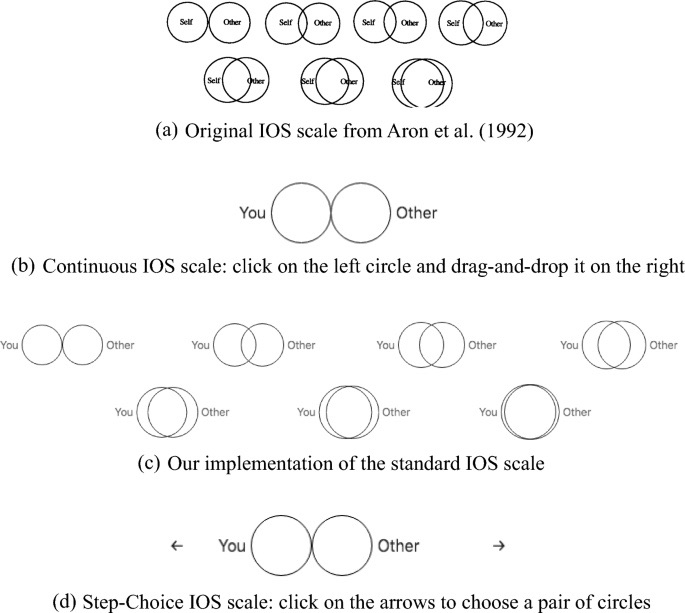
It shows seven pairs of circles, one labeled “self” and one labeled “other,” ranging from barely touching to almost completely overlapping.
Participants just pick the pair that best represents their relationship. It sounds almost too basic to be useful, but it’s been used across hundreds of studies as a quick, intuitive way to gauge relational closeness.
Why the Honeymoon Phase Fades
This framework also offers a tidy explanation for why new relationships feel so intoxicating and why that intensity almost always cools.
Early on, the rate of self-expansion is enormous. Everything about the other person is new, so every interaction delivers a jolt of novelty and growth.
Over time, though, you’ve absorbed most of what there is to absorb, and the pace of expansion naturally slows. That’s not a sign of failure. It’s just the plateau that comes after a steep climb.
The theory suggests that couples who want to keep some of that spark alive should deliberately seek out new, challenging, or exciting activities together, because shared novelty reopens the door to expansion even after the initial rush has faded.
The Harder Side of the Theory
There’s a more sobering implication too. If a partner really does become woven into your sense of self, then a breakup isn’t just an emotional loss, it’s a kind of identity contraction.
Research on relationship dissolution has found that people often describe a diminished or confused sense of who they are after a split, which lines up with the idea that they’ve genuinely lost a piece of the self-concept they’d built around that person.
Why It’s Worth Knowing
What makes self-expansion theory appealing is that it reframes love as less about completion and more about growth. It’s less “you complete me” and more “you help me become more.” And practically speaking, it offers a fairly actionable takeaway for long-term couples: don’t just coast, keep introducing novelty and shared challenges, because that’s the same mechanism that made the early days feel so alive in the first place.
You don’t have to become less of yourself to make room for another person. Somehow, loving them makes your life, and your understanding of yourself, larger.
Sources and Further Reading
- Foundational and academic sources: the Self-expansion model overview on Wikipedia; “Self-Expansion Theory: Origins, Current Evidence, and Future Directions” in Wiley’s Social and Personality Psychology Compass; Aron’s 1996 paper “Love and expansion of the self: The state of the model” in Wiley Online Library; “The self-expansion model of motivation and cognition in close relationships” on ResearchGate; the chapter “The self-expansion model and optimal relationship development” from Cambridge University Press; “Self-Expansion Activities with a Partner as One Path to Well-Being” in MDPI; and a related open dataset on self-expansion potential versus behaviors via OSF.
- More accessible explainers: iResearchNet’s summary of self-expansion theory; a graduate thesis on friendships, romantic relationships, and self-expansion via Sycamore Scholars; and a lay-audience piece, “When Two Become One: The Self-Expansion Theory of Love,” from Marriage Pact.
- Video and interview material: “Why Do We Love?” featuring Arthur Aron on the On Humans YouTube channel; “Science of Love – Interview with Arthur Aron” on YouTube; and a short explainer titled “Arthur Aron’s Self-Expansion Theory | Psychology” also on YouTube.

Leave a Reply