Chicago Street Journal | Urban Culture & Affairs
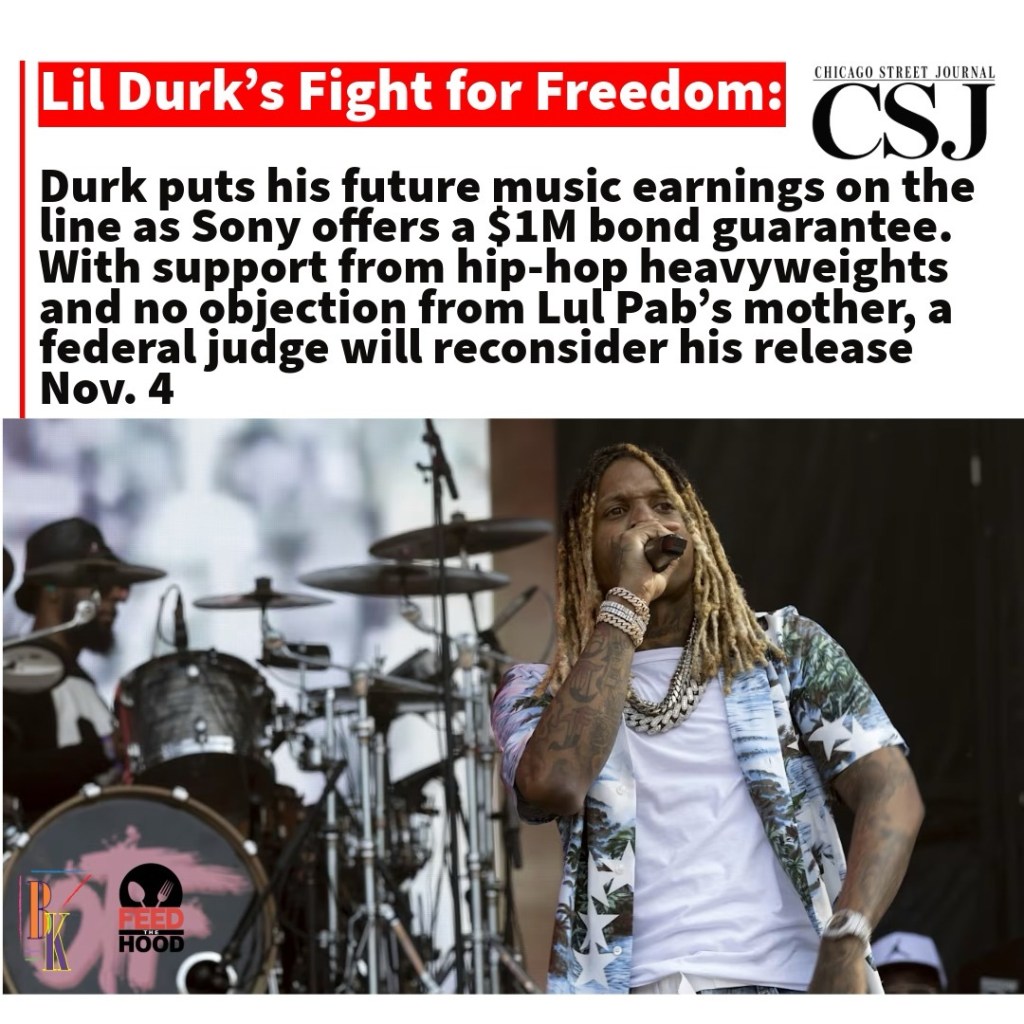
Sony offers a $1 million guarantee, hip-hop heavyweights back his release, and the mother of the man killed in the case does not object. Now a federal judge must decide whether Durk Banks can await his next trial outside custody.
Not Guilty & Still Not Free. Now He’s Putting His Future Earnings on the Line.
Chicago rapper Durk “Lil Durk” Banks is making another bid for freedom, and this time, his attorneys are offering more than cash and property.
In an October 27 federal court submission, Banks’ defense presented an expanded bond proposal involving future music royalties, publishing income, merchandise, touring revenue and earnings tied to his name and likeness.
The proposal is supported by letters from some of the biggest names in hip-hop and business, including JAY-Z, J. Cole and Michael Rubin. Sony Music Entertainment has also offered to guarantee an appearance bond of up to $1 million.
But one of the most consequential voices in the filing belongs to someone outside the music industry: Andrea Robinson, whose son, Saviay’a “Lul Pab” Robinson, was killed in the August 2022 shooting underlying the federal prosecution.
Robinson has informed the court that her family does not oppose Banks’ release if the judge considers it appropriate.
The submissions arrive nearly seven weeks after a federal jury acquitted Banks on all five counts tried in September. He remains detained while facing a separate murder-related racketeering prosecution.
His next bond hearing is scheduled for November 4.
A Bond Proposal Built Around His Career
Banks’ attorneys are attempting to address a central concern that has followed his previous requests for release: whether his financial resources could allow him to leave the country and remain beyond the court’s reach.
Rather than relying exclusively on cash, the new proposal would place future income from his music career at risk if he violated the conditions of release.
According to reporting on the October 27 motion, the proposed security includes royalties, music publishing interests, merchandise revenue, income from commercial use of Banks’ identity, potential touring earnings, cash and property pledged by supporters, and the home occupied by his mother.
The defense argues that these commitments would create substantial financial consequences for Banks and people close to him if he failed to appear in court.
The proposal goes beyond the earlier bond package that included millions in cash and residential property.
The difference is significant: Banks’ attorneys are now asking the court to consider not only what he owns today, but what his music career could earn in the future.
However, pledging future earnings does not automatically establish their current value or guarantee that the court could collect them. The judge must determine whether the proposed security is legally enforceable and sufficient to address the risks associated with release.
Sony Music Offers a $1 Million Guarantee
One of the clearest financial commitments appears in Exhibit F of the October 27 filing.
In a letter dated September 14, Sony Music Entertainment executive Stephanie Yu states that the company is prepared to guarantee an appearance bond for Banks of up to $1 million.
The letter also confirms Sony’s agreement that Banks may forfeit future earnings toward a bond in an amount determined by the court.
That is a substantial offer, but it should not be confused with a completed $1 million payment.
Sony is proposing a guarantee. Whether the court accepts it, how the guarantee would be structured, and what additional security might be required remain unresolved.
The court must also consider whether financial consequences would meaningfully reduce any risk of flight or danger to the community.
The Mother of Lul Pab Does Not Oppose Bond
Among the submissions supporting release, Andrea Robinson’s position carries particular significance.
Her son, Saviay’a Robinson, was killed during the August 19, 2022 shooting in Los Angeles. Federal prosecutors alleged that the intended target was rapper Quando Rondo, whose legal name is Tyquian Bowman.
Banks was acquitted of the charges tried in September, but the death remains central to the separate prosecution awaiting trial.
In a letter dated September 28, Andrea Robinson informed the court that her family does not object to Banks receiving bond if the judge determines that release is appropriate.
Her position is important for several reasons.
First, it gives the court a perspective from the family directly affected by the fatal shooting.
Second, it differs from an unconditional endorsement. Robinson leaves the decision to the judge.
Third, it comes after Banks’ acquittal but while serious allegations remain pending.
The statement does not establish that the family believes Banks is innocent of the remaining charges. Nor does it resolve the family’s loss or eliminate the government’s public-safety concerns.
The federal court retains responsibility for deciding whether release is legally appropriate.
JAY-Z, J. Cole and Others Make Their Case
Banks’ request is also supported by prominent figures who describe his professional relationships, community involvement and personal development.
JAY-Z’s letter discusses Banks’ career, his efforts to create opportunities for younger artists and the significance of the recent acquittal.
J. Cole offers a more personal account.
In his letter, Cole recalls working with Banks on their Grammy-winning collaboration, “All My Life.”
According to Cole, Banks insisted on using the song to communicate a message about growth and change, even when Cole initially suggested pursuing a different creative direction.
Cole also describes visiting a juvenile detention facility where young people repeatedly mentioned Banks and his music.
His argument is not that artistic success disproves criminal allegations. Rather, he presents Banks as someone whose influence can have a constructive effect on young audiences.
Former Cook County State’s Attorney Kim Foxx also submitted a letter supporting release.
Foxx emphasizes that Banks was acquitted of the charges tried in September and remains presumed innocent of the charges still pending.
Prison-reform advocate Andre Norman offers another form of support: a commitment to personally mentor Banks if he is released.
Norman proposes continued contact, accountability and potential participation in community programs, subject to court approval.
Taken together, the letters seek to establish that Banks would return to a network of family, professional relationships and community support rather than an unstructured environment.
Still, personal endorsements cannot replace the legal findings required for pretrial release.
What the Judge Must Decide
Under the federal Bail Reform Act, courts consider whether conditions of release can reasonably assure a defendant’s appearance and the safety of other people and the community.
Relevant considerations include the nature and circumstances of the charges, the weight of the evidence, the defendant’s history and characteristics, and the nature and seriousness of any danger posed by release.
The law also provides a rebuttable presumption favoring detention for certain serious charges, subject to the applicable statutory requirements.
Banks’ acquittal is relevant because the government failed to obtain convictions on the five counts submitted to the September jury.
But that verdict does not automatically require his release on charges that remain pending.
His attorneys argue that the acquittal changes the strength of the government’s case and should influence the court’s assessment of detention.
Prosecutors have opposed Banks’ release. Their position must be weighed alongside the defense’s new proposal, the remaining allegations, the court’s previous detention findings and the updated assessment from U.S. Probation and Pretrial Services.
The judge must consider whether conditions such as financial security, travel restrictions, monitoring and other safeguards could adequately address the applicable risks.
The presumption of innocence remains fundamental: Banks is not convicted of the charges awaiting trial.
But the presumption of innocence and the legal standards governing pretrial detention are separate questions.
Why the Acquittal Matters, and Why the Case Continues…
On September 11, a federal jury found Banks not guilty on all five counts tried in the murder-for-hire and stalking prosecution.
The verdict was a major victory for his defense.
Nevertheless, prosecutors are pursuing a separate charge involving murder in aid of racketeering, commonly associated with the federal VICAR statute.
That prosecution concerns allegations that have not been resolved by a jury verdict.
Banks has pleaded not guilty.
His attorneys have also suggested that constitutional protections against double jeopardy may provide grounds to challenge the remaining prosecution.
Whether that argument succeeds is a separate legal question requiring court consideration.
The September acquittal does not, by itself, establish that the remaining charges are prohibited.
November 4: The Next Decision
U.S. District Judge Michael W. Fitzgerald is scheduled to review Banks’ detention on November 4, 2026.
The next trial is currently scheduled for August 30, 2027.
Before then, the court must decide whether the latest financial proposal and supporting submissions sufficiently address the reasons Banks has remained in custody.
The decision could turn on more than the size of the proposed bond.
It may depend on whether the court believes the financial guarantees are enforceable, whether the proposed conditions adequately address flight risk, and whether release would be consistent with public safety.
For Banks, the stakes extend beyond a single hearing.
His legal team is offering the future value of his music career as security for his appearance in court.
His supporters are offering their reputations, professional relationships and personal commitments.
And the family of the man killed in the shooting has told the judge that it does not oppose release if the court finds it appropriate.
The jury has spoken on the first set of charges. The next decision belongs to the judge.
Whether Banks will await his next trial at home or remain in federal custody is still undecided.
Editorial Note
October 28, 2026: This report examines the renewed bond request and supporting exhibits filed October 27 in United States v. Grant, Case No. 2:24-cr-00621-MWF, U.S. District Court for the Central District of California.
The October 27 exhibit package has been reviewed. Descriptions of the complete financial proposal and the government’s opposition also rely on contemporaneous reporting because the full motion and any new written prosecution response were not independently obtained for this report.
The letters represent statements by their authors. They are not judicial findings. No order granting release on the new proposal was verified as of publication.
Chicago Street Journal will continue following the November 4 hearing and the remaining federal prosecution.

Leave a Reply