The Trial, Day by Day
The federal murder-for-hire case against Chicago rapper Durk “Lil Durk” Banks unfolded over several weeks in a Los Angeles courtroom. Prosecutors attempted to connect Banks to the 2022 shooting through cooperating witnesses, travel and financial records, digital communications, music and evidence of the long-running conflict surrounding the death of King Von. The defense attacked the credibility of the government’s cooperating witnesses and argued that prosecutors were trying to hold Banks responsible for actions carried out by other people.
Here is how the trial developed.
August 20-21:
The Jury Is Selected
Jury selection began August 20 with a pool of roughly 80 prospective jurors. Questions included whether potential jurors’ views of rap music, violent lyrics or hip-hop culture could interfere with their ability to judge the evidence impartially.
By August 21, the court had seated 12 jurors and four alternates. Opening statements were scheduled for the following Monday. (OurGavel)
August 24:
Day 1 | Two Completely Different Stories
Prosecutors opened by alleging Banks was “consumed with revenge” following the November 2020 killing of his friend and collaborator Dayvon “King Von” Bennett. Their theory was that Banks put a bounty on rapper Quando Rondo, whose legal name is Tyquian Bowman, and financed the group that traveled to California to kill him.
Bowman survived the August 19, 2022 attack, but his cousin, 24-year-old Saviay’a “Lul Pab” Robinson, was killed.
The defense presented a fundamentally different theory. Banks’ attorneys said he had nothing to do with ordering the shooting and pointed instead toward his former assistant Kavon “Vonnie” Grant, who later pleaded guilty and cooperated with prosecutors.
Jurors also began hearing from investigators about the shooting, surveillance footage, rental vehicles, travel records and other evidence used to reconstruct the group’s movements. (Los Angeles Times)
August 25:
Day 2 | King Von, Digital Evidence and the Government’s Motive Theory
The prosecution moved backward to the November 2020 killing of King Von, attempting to establish the motive it said eventually produced the California shooting.
Jurors heard about Banks’ communications after Von’s death and saw electronic evidence investigators believed reflected escalating hostility toward Bowman and his associates.
Investigators also walked jurors through airline, rental-car, GPS and other records connecting members of the alleged conspiracy to California. An ATF agent testified about the firearms visible in surveillance footage, while an LAPD detective discussed data recovered from a phone associated with Banks.
The defense challenged the context prosecutors placed around Banks’ words and associations. (OurGavel)
August 26:
Day 3 | OTF Jam Names Durk
Jerome Kacey “OTF Jam” Hester became one of the prosecution’s most consequential witnesses.
Hester admitted being one of the gunmen involved in the shooting that killed Robinson. He identified himself in surveillance footage and implicated Banks, David Lindsey and Deandre Wilson in the alleged plot.
Asked why Bowman was targeted, Hester testified that it was retaliation for King Von’s killing.
His testimony mattered because prosecutors were no longer asking jurors to infer Banks’ involvement solely from messages, music, travel and financial records. An admitted participant was directly accusing him.
But Hester was also a cooperating witness awaiting sentencing, making his credibility and incentive to cooperate central issues for the defense. (Complex)
August 27:
Day 4 | Hester Describes the Alleged Operation
Hester continued his testimony and described what he said was the plan to locate and kill Bowman.
He testified about being called into the operation, traveling to California, attempts to locate Bowman and his own role as a shooter. According to Hester, an earlier opportunity was abandoned when police were present.
Defense attorney Brian Steel then began cross-examining him, shifting attention from what Hester alleged happened to whether jurors should trust the man telling them it happened. ( OurGavel)
August 28:
Day 5| The Defense Attacks Hester’s Credibility
Steel’s cross-examination focused heavily on Hester’s criminal history, cooperation with the government and the possibility that his testimony could help reduce the punishment he faces.
The defense also challenged inconsistencies in his account and emphasized places where it argued Hester’s allegations against Banks lacked independent corroboration.
The central question became larger than whether Hester participated in the shooting. He admitted that he did. The question for Banks was whether Hester could reliably establish that Banks ordered or financed it. (OurGavel)
August 31:
Day 6 | Keith “Flakka” Jones and Kavon “Vonnie” Grant
Another admitted shooter, Keith “Flakka” Jones, testified for approximately five hours.
Jones became important to the government’s effort to explain how the alleged plot operated and how participants expected to be compensated.
Later, Kavon “Vonnie” Grant, Banks’ former assistant and another cooperating co-defendant, took the stand. Grant had extensive access to Banks’ travel arrangements and resources, a fact that became important to both sides: prosecutors used his insider position to support their case, while the defense argued that the same access gave Grant the ability to organize events without Banks directing him.
Banks’ sound engineer Justin Gibson testified that he had traveled with Banks and Grant before the shooting but did not hear them planning a murder or discussing Bowman’s location. Prosecutors challenged Gibson with lyrics they argued referred to retaliatory violence.
Grant’s testimony continued the following day. (Legal Affairs and Trials)
September 1:
Day 7 | Grant Becomes a Central Witness
Grant testified for roughly five and a half hours.
His testimony placed one of Banks’ closest former insiders directly before the jury. Prosecutors relied on Grant to connect Banks to the alleged operation.
The defense, however, had built much of its case around a competing proposition: Grant was not merely an assistant carrying out Banks’ instructions but a person with his own motive, relationships and access to the resources used by the group.
That conflict became one of the defining factual questions of the trial: was Grant describing Banks’ plan, or was Banks being blamed for a plan Grant helped create himself? (Legal Affairs and Trials)
September 2:
Day 8 | FBI Agents, Messages and the Arrest
The prosecution turned back toward federal investigators.
FBI Agent Cody Burke testified about text messages, voicemails, Instagram communications and a portion of Banks’ interview with DJ Akademiks.
Another FBI agent testified about Banks’ October 2024 arrest in Florida and the government’s interpretation of his travel plans. Prosecutors had portrayed the circumstances as evidence that Banks was attempting to leave the country after associates were arrested.
The defense disputed the government’s interpretation of both his communications and his travel. (Legal Affairs and Trials)
September 3:
The Government Rests and the Defense Takes Over
The prosecution called its final witnesses and rested at approximately 10:29 a.m.
The defense then began presenting its own witnesses.
Kevin Freeman, who worked with Banks through Neighborhood Heroes, testified about advice that Banks “lay low” while an attorney investigated whether authorities were seeking him.
Tour manager Jeremais Marcano testified about a wedding invitation in Mexico, evidence the defense used to offer an alternative explanation for a message prosecutors associated with travel arrangements.
Brianna Dangerfield, who had been romantically involved with Hester, attacked Hester’s credibility and described him as manipulative and untruthful.
Music executive Sanchay Jain provided context for Banks’ music and an unreleased video prosecutors had shown the jury.
Shekema Springfield and Ryan Green offered testimony supporting the defense theory that Grant himself wanted retaliation following King Von’s death.
Gibson was the final witness. The prosecution did not call rebuttal witnesses. (Legal Affairs and Trials)
September 4:
Day 9 | The Case Moves Toward the Jury
The official transcript index identifies September 4 as Trial Day 9. Because the witness presentation had concluded the previous day, this portion of the proceedings moved the case toward its final arguments and submission to the jury.
Rather than attribute additional testimony to September 4 that we have not independently verified from the transcript, CSJ is identifying the date as part of the trial record while keeping the substantive witness account tied to the dates on which the testimony is documented. (The Talk Lounge)
September 8:
Day 10 | Closing Arguments
Both sides finally told jurors what they believed the evidence meant.
Prosecutors argued that the witnesses, money, travel, communications, music and surrounding circumstances fit together into one story: Banks wanted revenge and used his resources and influence to make it happen.
Banks’ attorneys attacked that interpretation.
They portrayed cooperating witnesses Hester, Jones and Grant as men with powerful incentives to help prosecutors and argued that Grant had both the motive and access necessary to act independently.
The defense also challenged the government’s interpretation of Banks’ music and his DJ Akademiks interview, arguing that prosecutors were extracting incriminating meaning from artistic expression and selected communications rather than proving that Banks ordered the shooting. (Los Angeles Times)
September 9-11:
Three Days of Deliberations
The jury deliberated for three days.
During deliberations, jurors requested the digital evidence and sought clarification concerning conspiracy and the meaning of intent under the stalking instructions.
Those questions were significant because the government had presented a substantial amount of evidence showing that a shooting and coordinated operation occurred. The separate question jurors had to answer was whether prosecutors proved Banks’ own criminal responsibility beyond a reasonable doubt. (Legal Affairs and Trials)
September 11:
Lil Durk Is Acquitted on All Five Counts
The jury returned its verdict September 11.
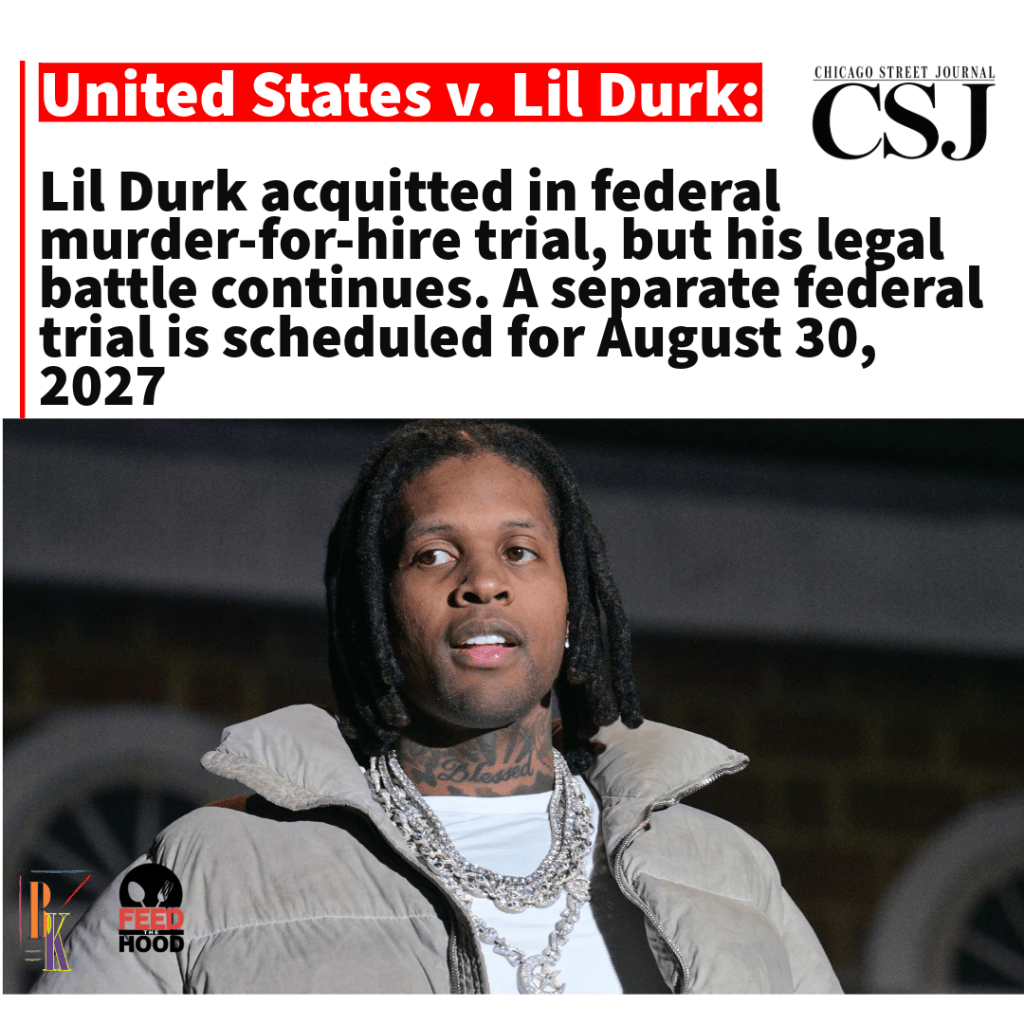
Durk Banks was found not guilty on all five counts he faced.
His co-defendants David Lindsey and Deandre Wilson were acquitted of the murder-for-hire charges but convicted of conspiracy to commit stalking and two stalking counts. One stalking conviction involved a finding that the conduct resulted in Robinson’s death. (Los Angeles Times)
The verdict did not establish that the California shooting never occurred, nor did it erase the admitted participation of cooperating witnesses.
It established something more specific and legally important: the government did not persuade this jury beyond a reasonable doubt that Banks was criminally responsible for the five offenses charged against him in this trial.
The Case Is Not Over
Banks did not walk out of the courthouse after his acquittal.
Separate racketeering-related charges had been severed from the murder-for-hire case before trial. He therefore remained in federal custody while that second prosecution continued.
At the time of the September 11 verdict, the second trial had been tentatively scheduled for October 5, 2026.
That date has now changed.
On September 30, U.S. District Judge Michael W. Fitzgerald approved a continuance moving the second federal trial to August 30, 2027. The parties cited the complexity of the prosecution, volume of discovery and additional preparation required. (Complex)
Banks’ more immediate legal battle will concern his freedom while that case is pending.
A bond-review hearing is scheduled for November 4, 2026, at 2:30 p.m. The court has ordered an updated bail report, and Banks’ attorneys are seeking his release while he awaits the second trial. (Complex)
There has also been movement involving his former co-defendants. David Lindsey has filed a renewed motion asking Judge Fitzgerald to set aside his stalking convictions or grant a new trial, arguing in part that the government’s cooperating witnesses testified that Bowman, rather than Robinson, was the intended target. A hearing on that motion is reportedly scheduled for October 28. The filing is a defense request, not a ruling overturning Lindsey’s convictions. (Complex)
34 Years of Life, What Has He Learned?
On October 19, 2026, Durk “Lil Durk” Banks turned 34 while in federal custody. His birthday arrived after a jury’s not-guilty verdict, but with another federal trial still ahead.
At 34, Banks has experienced fame, fortune, loss, fatherhood, and the consequences of living much of his life in the public eye. Yet one question remains beyond the courtroom’s reach: What has this chapter of his life taught him?
Has it changed how he views loyalty, relationships, influence, or the responsibilities that come with success? Has time away from his family and career shifted his perspective on the life he wants to lead?
Those are questions only Durk can answer.
For now, the legal proceedings continue, and the public is left watching a story that extends beyond music, celebrity, and the courtroom.
And perhaps the most important part of his story has yet to be told.

Leave a Reply